

A new architecture for maritime governance

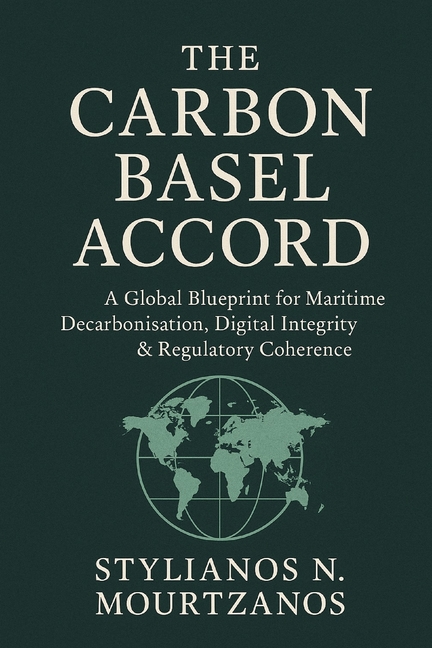
The Carbon
Basel Accord.

A Global Blueprint for Maritime Decarbonisation, Digital Integrity & Regulatory Coherence

By Stylianos N. Mourtzanos
Captain · MBA · AFNI

Explore the vision

One industry. A shared direction.

The vision

01 / 05

One ocean.
Many rules.
A shared direction.

A global industry needs a coherent foundation.

The Carbon Basel Accord brings measurement, markets and accountability into one proposed architecture for maritime governance.

Explore the three pillars
DecarbonisationDigital integrityRegulatory coherence

The book

02 / 05

A blueprint for
an industry
in transition.

Shipping connects the world.
Its governance should work as one.

The Carbon Basel Accord by Stylianos N. Mourtzanos proposes a policy framework for maritime decarbonisation. Inspired by the Basel Accords in finance, it connects emissions measurement, carbon pricing and supervision across jurisdictions.

It asks how common standards, credible data and clear responsibilities can give a fragmented system a shared direction.

Paperback
76 pages
Kindle
109 pages
Language
English
Published

Available in Kindle, paperback & hardcover

The architecture

03 / 05

Three pillars.
One foundation.

A framework for aligning the evidence, the incentives and the institutions that shape maritime decarbonisation.

Pillar I: Global MeasurementA common language
for carbon.

Comparable emissions data is the starting point. The first pillar aligns measurement, reporting and verification with lifecycle assessment, creating a shared basis for evaluating ships and fuels.

  • Emissions reporting
  • Lifecycle assessment
  • Verification

Pillar II: Interoperable Carbon PricingDifferent systems.
Compatible signals.

The second pillar addresses equivalence between emissions trading, market-based measures and fuel standards. It explores how distinct regimes can work together to create a more coherent economic signal for decarbonisation.

  • Carbon markets
  • Pricing equivalence
  • Fuel standards

Pillar III: Coordinated SupervisionShared standards.
Clear responsibilities.

The third pillar connects flag administrations, classification societies, port State control and verifiers. Supervisory coordination and defined responsibilities support credible implementation across institutions.

  • Flag administrations
  • Class & PSC
  • Verifiers

An independent policy proposal by Stylianos Mourtzanos.

A container ship crossing the open sea, viewed from above

Beyond carbon

A global transition.
A question of trust.

The ocean connects us.

An interconnected world

04 / 05

The systems behind
the transition.

Carbon governance depends on the integrity of the systems around it. The book looks beyond emissions to the conditions that make progress credible.

01Digital integrity

Cybersecurity, identity governance and reliable data underpin the credibility of carbon systems.

02Fuel governance

Harmonised lifecycle assessment, digital fuel passports and supply-chain transparency connect fuel claims to their evidence.

03Geopolitical resilience

Sanctions exposure and shadow-fleet activity test the credibility and reach of maritime governance.

04From vision to practice

Actor responsibility maps, phased implementation and future scenarios bring the proposed architecture into practical focus.

The framework at a glance

Explore the book

What is
The Carbon Basel Accord?

The Carbon Basel Accord: A Global Blueprint for Maritime Decarbonisation, Digital Integrity & Regulatory Coherence is a book by Stylianos N. Mourtzanos, published in December 2025.

In brief: it proposes a Three-Pillar framework connecting Global Measurement, Interoperable Carbon Pricing and Coordinated Supervision. Its central concern is maritime regulatory coherence: how credible data, compatible carbon markets and accountable institutions can work together across jurisdictions.

Pillar I: Global Measurement

  • Comparable emissions data: align measurement, reporting and verification as a common basis for maritime carbon governance.
  • LCA harmonisation: examine consistent life-cycle assessment methods for comparing marine fuels and their greenhouse-gas emissions.

Pillar II: Interoperable Carbon Pricing

  • ETS and MBM integration: explore interoperability between emissions trading systems (ETS) and other market-based measures (MBMs).
  • Coherent incentives: examine how carbon markets and fuel standards can provide compatible signals for maritime decarbonisation.

Pillar III: Coordinated Supervision

  • Institutional coordination: connect the responsibilities of flag administrations, classification societies, port State control and verifiers.
  • Accountable implementation: establish clearer responsibilities and supervisory cooperation across maritime carbon-governance systems.

Digital integrity & governance resilience

  • Digital fuel passports: connect fuel claims with supply-chain transparency, identity governance and reliable emissions records.
  • Shadow fleet mitigation: consider sanctions exposure, traceability and the reach of maritime supervision as governance challenges.
Author
Stylianos N. Mourtzanos
Publication
Paperback ISBN
9798278211402
Framework status
Independent policy proposal

Book reference updated .

The author

05 / 05

Captain · MBA · AFNI

Stylianos N.
Mourtzanos.

Bringing the realities of shipping into the debate on its future.

Stylianos Mourtzanos is a maritime strategist and HSQE & vetting professional with a background at sea. His work spans regulatory compliance, safety assurance, maritime decarbonisation and digital transformation.

The Carbon Basel Accord brings these connected interests into a single proposal for global maritime governance.

Connect on LinkedIn (opens in a new tab)

Fragmentation is no longer a compliance problem, it’s a systemic risk.

Stylianos Mourtzanos
On The Carbon Basel Accord (opens in a new tab)

The Carbon Basel Accord

The future needs
a shared direction.

Explore a blueprint for the next chapter of maritime governance.

Kindle · Paperback · Hardcover

Paperback ISBN 9798278211402

View the paperback listing on Walmart (opens in a new tab)